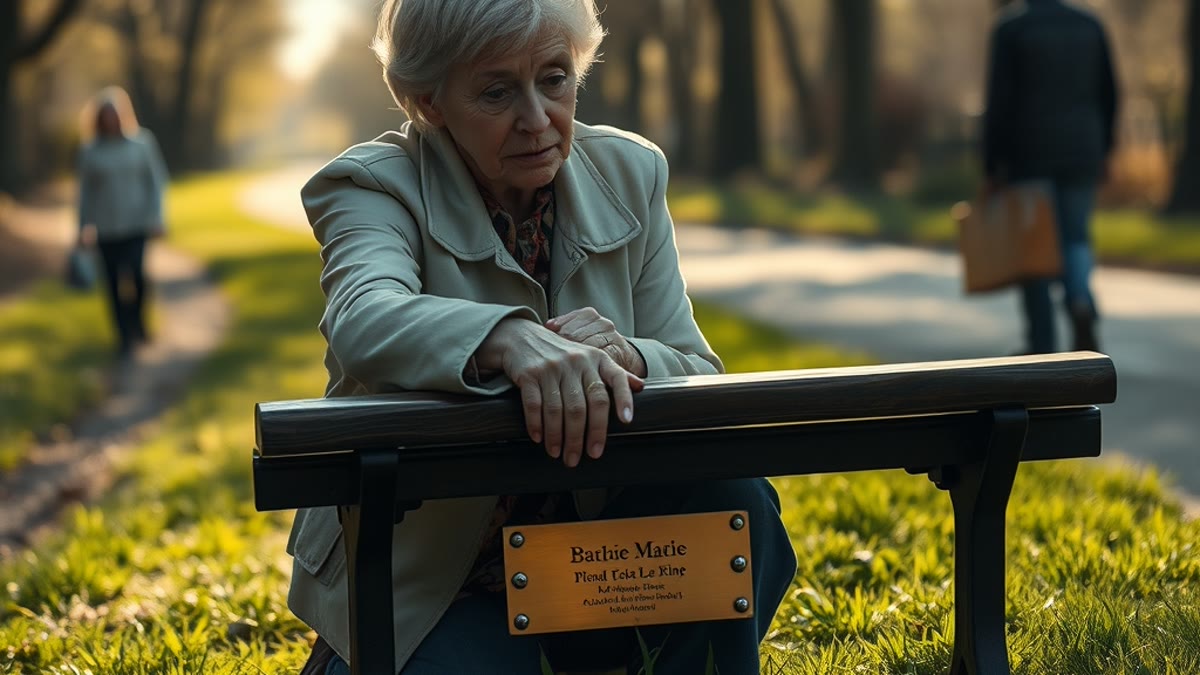
The brass was warm and the oil wasn't dry yet. Somebody had been there that morning.
Previously: The city is taking out the old benches in June. I went down to say goodbye to the one my husband put in twenty-six years ago — and found the brass polished bright, the screws replaced, and the oil on the wood still wet.
I stood up out of that grass a lot faster than my knee had any business allowing, and I looked down the path, and there was a man about a hundred yards off walking away with a toolbox.
I called out. I'm not a woman who calls out to strangers in parks. I called out anyway.
He stopped, and turned around, and stood there a second, and then he came back.
He was about my age. Heavy work jacket in May, the kind of hands you get from fifty years of a trade, hair gone completely white.
He had a rag hanging out of the toolbox and his fingers were dark with oil.
He got about ten feet away and stopped and said, "You're Gordon Ridley's wife."
I said, "How do you know that?"
And he said, "Because I've been waiting twenty-six years for somebody to come ask me that, and I always figured it'd be you."
His name is Sam Petrella. He had a shop on Fremont Street until 2009 — small millwork, signs, brass and wood, the kind of business that doesn't exist anymore.
In March of 1999 a man came in with a piece of paper in his shirt pocket and asked what it would cost to have one line put on a brass plate.
"Twelve dollars," Sam said. "That's what I charged him. Twelve dollars, and he paid it in ones and a five."
Gordon had written the line out longhand. Sam laid it out, cut the plate, and hand-engraved it over two evenings, because he did that work by hand and by 1999 nobody under sixty wanted to pay for it.
Gordon came to pick it up on a Thursday.
"He read it about six times standing at my counter," Sam said.
"And then he said, 'Sam, I'm not sure I've got the words right. Can a fella have it done over?'"
Sam told him yes. Of course. Bring it back, he'd cut a new plate, charge him for the brass and not the labor.
And Gordon said — Sam remembers this exactly, and he said it to me standing on a paved path in a park with his toolbox at his feet —
"Let me live with it over the summer. I'll come back in the spring and we'll get it right."
He put the bench in in April. He got his diagnosis in July. He died the eleventh of November.
He never came back.
I want you to understand what Sam Petrella did with that.
He did not think of it as a memorial. He thought of it as a job that hadn't been closed out.
"The man asked me to hold the work open," he said. "So I held it open."
That spring — spring of 2000, five months after my husband died — Sam walked down to that bench with a can of tung oil and a rag and a brass polish and he went over the whole thing, because a plate he'd cut was sitting out in Ohio weather and it was going to go green, and Sam Petrella has never in his life let a piece of his own work go green.
And then he did it again the next spring. And the next.
"After about five years it wasn't about the job anymore," he said.
"By then it was just a thing I did the first warm week. Wife used to pack me a sandwich for it.
She thought it was funny. She called it my Tuesday with the bench."
His wife's name was Roseann. She died in 2011.
"After that," Sam said, "I'll be honest with you, it stopped being funny and started being the reason I got out of the truck in April."
The screws.
I asked about the screws, because that was the thing that put me on my knees in the grass — two bright new stainless screws in a plate that's been outside since Clinton.
He'd changed them in 2014. The originals were plated steel and they'd started to weep rust down the wood, and rust stains in oak don't come out.
"Had to drill one of 'em," he said.
"Took me an hour and a half. I was seventy years old, kneeling in the mud, drilling out a screw on a park bench that isn't mine."
He laughed at himself. "If a cop had come along I'd have had a time explaining it."
Then I asked him the thing I'd been not-asking for twenty minutes.
I said, "Do you know what it says?"
And Sam said, "Ma'am, I cut it. I know it the way you know a thing you did with a graver and a magnifier over two nights."
I said, "Do you know what it means?"
And he was quiet for a second, and then he said:
"He told me. He stood at my counter and told me why, because I asked him — I shouldn't have, it's not my business what a man puts on a plate, but I asked him."
He looked at the bench and not at me. "And that's why I told him not to change it.
He said he wasn't sure he'd got the words right and I said, Mr. Ridley, you've got them right.
Leave them be."
I'm not going to type the line here. I've said that once already and I meant it.
It's eleven words that would mean nothing to you and everything to two people, one of whom has been dead since 1999.
But I'll tell you this much: it's not romantic. It's not a quote and it's not from a hymn.
It's an ordinary sentence about an ordinary Sunday, the kind of thing that only becomes enormous if you were there for it.
My husband, who could not say a soft thing out loud to save his life, spent twelve dollars and two of another man's evenings putting that Sunday on a piece of brass in a public park, and then didn't tell me, and then died worrying he'd worded it wrong.
They took the benches out on the ninth of June.
I want to be honest that I fought it for about ten days and lost, and I want to be honest that I lost because the parks department was right. Those 1990s benches are backless-adjacent, the seat height is wrong, and the new composite ones have arms, which for a woman my age is the difference between sitting down in a park and not.
Sam and I went down on the seventh with his tools.
He took the plate off, and then — this was his idea, and he'd clearly been chewing on it since March — he cut out the middle section of the backrest. The two slats with the good grain, the ones his oil had been going into for twenty-six years.
The city said we could have it. The foreman actually helped him carry it to the truck.
It sat in Sam's garage until August.
What it is now is a small wall shelf. About thirty inches.
The two original oak slats, dressed and joined, with a little bracket underneath he cut out of the same brass stock as the plate.
The plate is set into the face of it.
It hangs in my front hall where the coat hooks used to be, which is where I see it eleven times a day, which is the point.
He wouldn't take money for it. We had an actual argument about it in his driveway, and what we settled on is that I make the lunch on bench day, which is a deal I'd have taken instantly if he'd offered it up front and which I suspect he knew.
Because there's still a bench day.
There's a new bench at that bend now. Composite, gray, with arms, bolted to a concrete pad, and the city put a small anonymous plaque on it because I asked and paid the sixty-five dollar fee — a new line, one I chose, and no, I'm not typing that one either.
Composite doesn't need oiling. Brass does.
So the first warm week of April, Sam Petrella comes down there with a rag and the polish and about forty minutes of work that could be done in ten, and I bring sandwiches, and we sit on a gray bench that neither of us likes and talk about Roseann and Gordon and what the park used to look like before they took the elms.
He's seventy-two. I'm sixty-nine.
I want to be careful about what I say here, because I know what people do with a story like this and I have three grown grandchildren who read everything I write.
We are not anything. We're two people who are the only two people alive who know what eleven words on a piece of brass mean.
That's not nothing. At sixty-nine, that is a very long way from nothing.
Here's what I actually came here to say.
For twenty-six years I believed my husband did one quiet thing for me and then died.
He didn't. He did one quiet thing for me and then another man kept it alive for a quarter of a century — for free, without ever being thanked, without any expectation that anyone would ever find out, because a customer asked him to hold a job open and then didn't come back.
I walked past the long way around that pond for twenty-six years thinking I was the only one carrying it.
There was a man with a rag and a can of oil down there every April the whole time.
If somebody you love died and you think their small good things died with them — go and look at the thing. Actually look at it. Kneel down if your knee will let you.
You may find the wood is not as weathered as twenty-six years should have made it.
She kept the paperwork — that is why it held up.
Are your own documents where someone could find them?