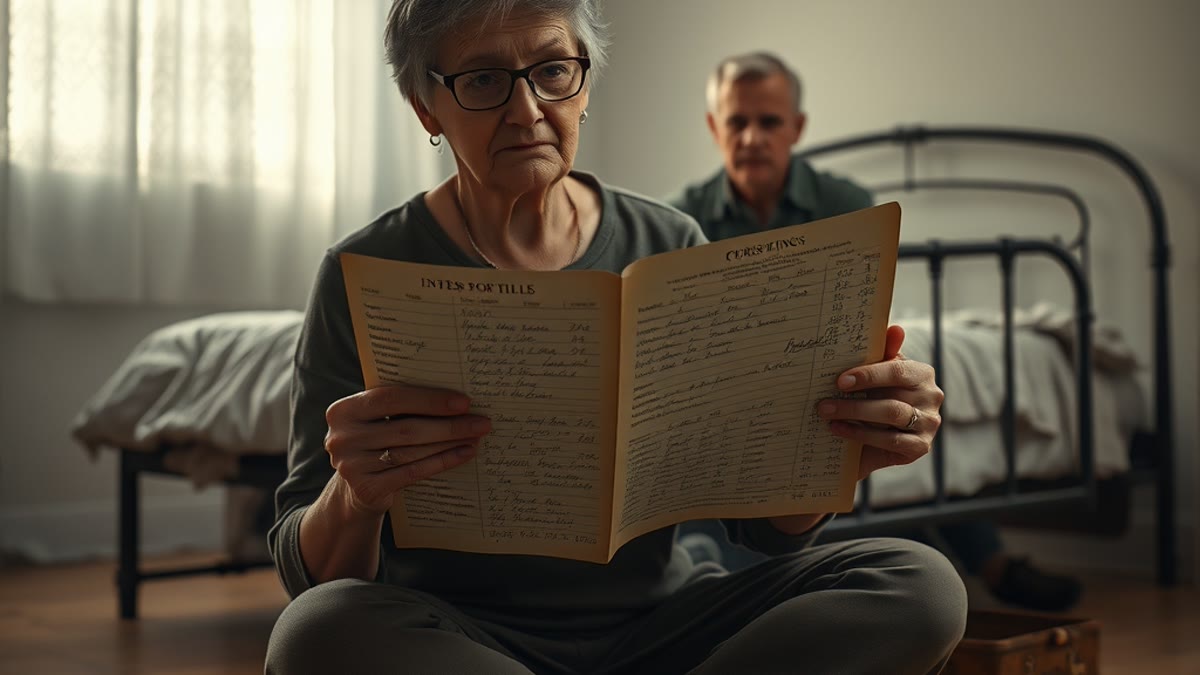
My husband pulled a cookie tin out from under Mama's bed and the first thing in it was a hospital bill.
Previously: Six days after we buried my mother, my husband pulled a rusted cookie tin out from under her bed. Inside was a 1979 hospital bill for $4,180, stamped PAID IN FULL — and the whole back of it was covered in different handwriting.
Forty-one names.
I counted them three times on the floor of that bedroom because I kept losing my place, and the third time I got forty-one, and then I understood that the forty-first was my mother's, at the bottom, in the corner, smaller than all the rest.
Ada Lee Hollins — whatever it takes.
Everyone else had written a number.
Verna Skaggs — $200.00 R. & M. Deitrich — $100.00 Pastor Cobb & Mrs. Cobb — $75.00 The Fowler girls — $60.00 C. Ruggles — $25.00
Down and down, in ballpoint and pencil and one in what I'd swear was a laundry marker, forty households in a town that had one stoplight and lost the shoe plant in 1974.
And through most of the names — not all, but most — somebody had drawn one clean horizontal line.
Verna Skaggs is ninety-four and lives with her granddaughter out past the grain elevator. She worked the desk at the Starlite for thirty years, which is where she and my mother became what they became, which was closer than sisters and about half as polite about it.
I brought the bill. I laid it on her kitchen table and she put on the glasses that hang around her neck and she looked at it for a long moment, and then she laughed — one short surprised note — and said:
"Well, I'll be. She kept the thing."
"Verna. What is this."
"That," Verna said, "is a Tuesday night in the basement of First Christian in March of 1979."
She told me the whole thing in about eleven minutes, the way old women tell you things, with the important part buried in the middle.
Wade was in Baptist Memorial in Toledo. Rheumatic fever, and it had gone at his heart, and they were talking about how long he'd be in.
My mother had ninety-one dollars a week and three kids and no husband, and the hospital wanted a number nobody in that town had ever seen written down outside of a mortgage.
"Your mother would not have taken a collection," Verna said.
"Not in a hundred years. That woman would have sold the house out from under all four of you before she'd have stood in front of that church and asked."
"So how—"
"So we didn't ask her." Verna folded her hands. "Pastor Cobb let us have the basement. We didn't call it a collection, either. Ray Deitrich was the one that came up with it. He said, 'Ada won't take charity, but Ada will take a loan.'"
That's why the numbers are on the back of the bill.
Forty households, one Tuesday night, each one writing down what they could carry — not what they wanted to give, what they could carry — and signing it. Not a donation sheet. A ledger of debts. Forty separate loans, no interest, no term, no collateral, in a town where nobody had anything.
"We handed her the paper and the receipt at the same time," Verna said.
"So she'd know it was hers to pay back and not hers to be ashamed of. She sat down on the church steps and cried for about ten minutes and then she went to work Wednesday morning at six."
She paid all forty of them.
That's what the horizontal lines are. She'd take a name, and she'd work at it — extra shifts, then houses, then mending at the kitchen table with the radio on — and when it was square she'd draw one line through it and start on the next.
It took her thirty-eight years.
Verna's line went through in 1984. The Deitrichs in 1991.
Pastor Cobb had died by the time she got to him and she paid his widow in 1996 in an envelope she left in the collection plate with the widow's name on it, which the widow told Verna about, which is the only reason anybody knows.
I sat on Verna's kitchen floor — I seem to end up on floors lately — and I went down that list of names and matched them against my own childhood.
The year we didn't have a Christmas tree: 1987. There's a line drawn through T. & B. Oyler — $150.00 dated the same December.
The two winters she took the second job at the laundry in Fostoria, driving thirty-one miles each way in a car with no heat: 1994, 1995. Three names crossed off.
I was a grown woman with children of my own. I thought she took that job because she was stubborn. I told her she was being stubborn. I remember saying, "Mama, nobody's making you do this."
Nobody was. Forty people had explicitly told her she never had to.
There's one name I want to tell you about specifically.
Fourteen lines down, in handwriting that is unmistakably a child's — big, careful, sloping down to the right off the ruled line:
Denny Ruggles — $4.00
Denny was C. Ruggles's boy.
He was ten years old in March of 1979 and he was in that church basement because his parents were, and when the paper went around the room he took it and he put down four dollars, which Verna says was the entire contents of a Band-Aid tin he kept under his bed and had been filling since he was seven.
My mother paid Denny Ruggles back in 2011.
He was fifty-three years old and living in Lima and she got his address off Verna and she mailed him four dollars and a note.
Verna says he called her afterward and could hardly talk.
Now here is the part I did not have until three weeks ago, and it is the reason I'm writing any of this down.
There are two names on that bill with no line through them.
P. & J. Hollenbaugh — $50.00 Marie Trout — $30.00
Eighty dollars. Out of four thousand one hundred and eighty.
My mother spent the last three days of her life gripping my hand and saying I owe people, and I have carried, since the funeral, a very specific and very heavy version of that: that she died eighty dollars short. That the woman cleaned motel rooms for forty-one years and came up eighty dollars short and knew it.
That's not what happened.
Verna told me flat out. "She tried to pay both of them four or five times over the years.
They wouldn't take it. Marie sent the money order back twice."
"Why?"
And Verna, who does not get sentimental, went quiet for a second.
"Because the Hollenbaughs lost their Danny in 1971," she said.
"Same thing. Rheumatic fever, and it went at his heart, and he was eight.
And Marie Trout lost a little girl in 1966, different thing, but the same size hole."
She took her glasses off.
"Honey. Those two families didn't put money in for your brother.
They put it in for their own. And when your mother came around trying to give it back, she was asking them to undo the one good thing that ever came out of the worst year of their lives."
Verna shook her head. "They'd rather be owed forever."
So my mother died owing eighty dollars that nobody on this earth would accept, and it stayed on her chest for forty-six years, and at the very end she couldn't put it down.
That's what she was telling me. And I patted her arm and said you don't owe anybody anything, Mama, because I didn't know, and she couldn't explain it anymore by then, and she just kept saying it, harder, over and over, until she stopped.
I've had to make my peace with that.
Here's what I did, and I ran it past Verna first, and past Marie Trout's niece, and past the Hollenbaughs' surviving son in Arizona, and all three of them said the same thing, which was: your mother would have liked that.
I wrote a check to the pediatric fund at the hospital in Toledo — the one Baptist Memorial rolled into in the nineties.
Eighty dollars. Not a dollar more, because that's the debt and my mother was precise.
And on the memo line I put two names.
Danny Hollenbaugh. Sue Ann Trout.
Neither of them made it out of childhood. Both of their families put money on a piece of paper in a church basement in 1979 so that my brother would.
Wade is fifty-eight. He's got a bad valve and a good cardiologist and two grandchildren, and last month he sat in my kitchen and read the back of that bill and put his head in his hands.
Then I took the paper, and I drew two lines.
If you're wondering what to do with something like this: I'd have burned it, five years ago. I'd have said it was morbid to keep a hospital bill under your bed for forty-six years.
I understand now that it wasn't a bill. It was a list of forty people who decided, on one Tuesday night in a town with one stoplight, that a motel maid's kid was going to live.
She kept it where she could reach it.
She kept the paperwork — that is why it held up.
Are your own documents where someone could find them?