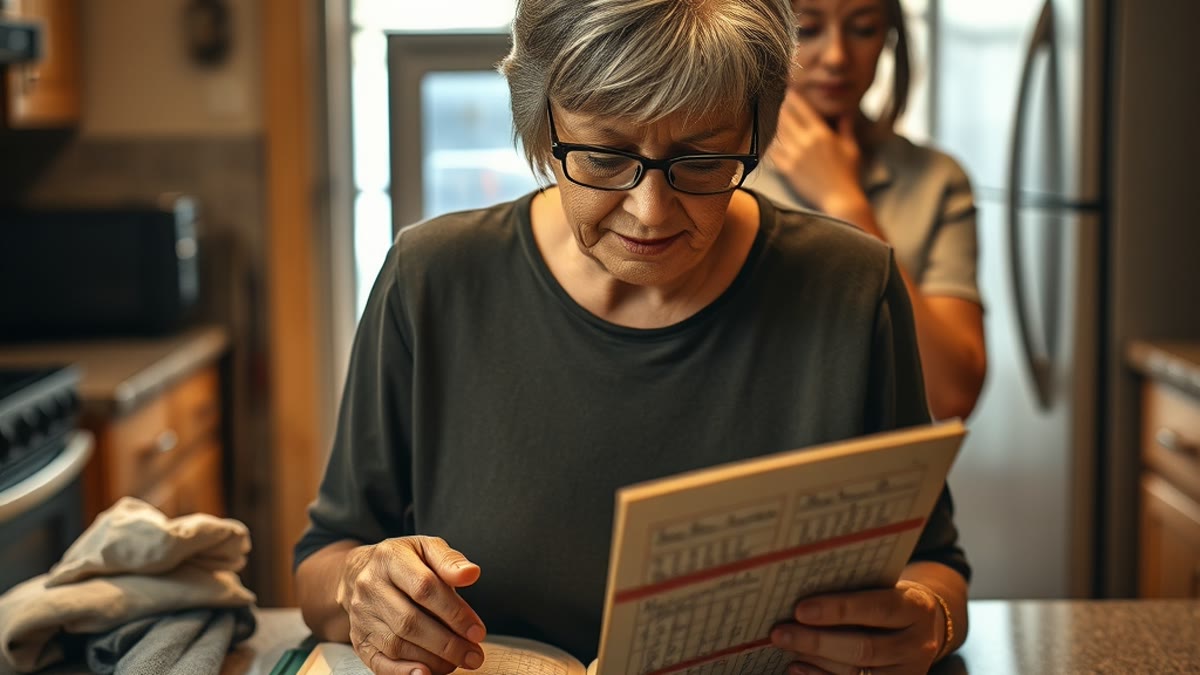
He wouldn't let me clean out the deep freezer. Now I know what was under the ice.
Previously: Three months after I buried my husband, my daughter found a ledger frozen to the bottom of the deep freezer — twenty-three years of payments, the fifteenth of every month, to a woman I'd never heard of.
The first line was dated November 20, 1997.
Under it, in Vern's small square handwriting, pressed so hard the pen had gone through: C. Whitlock — 140.00. And then, off to the side, in the margin where the columns didn't reach, four words that were not part of any accounting system I've ever seen.
1 of 360. Started.
I sat down at the kitchen table without meaning to. Dana got me a glass of water I didn't drink.
Three hundred and sixty. I did the arithmetic the way you do when your hands are cold. Twelve a year. Thirty years.
My husband had sat down at some point in November of 1997, at forty-four years old, and worked out how long he was going to be doing this, and then written the number down like a man setting a fence post.
"Mom." Dana had the ledger turned toward her now, going forward through the pages. "It's not the same amount the whole way. It goes up."
It did. One-forty a month for the first six years.
Then one-seventy-five. Then two-twenty-five in 2011, which was the year the mill cut his hours and we ate a lot of soup.
Then three hundred in 2019, which was the year he told me we couldn't do the trip to see my sister in Arizona.
I want you to understand what I felt right then, because it wasn't what I expected to feel and I've had to sit with it since.
It wasn't grief. It was fury.
Because I knew exactly what I was looking at. I was looking at every kitchen chair we didn't replace.
Every winter he wore that coat with the split seam. The year I wanted the good hearing aids and he said we'd see how the cheap ones did, and we saw, and they didn't do, and I said fine.
Somebody had been getting three hundred dollars a month of my life and I didn't know her name.
Charlene Whitlock lived forty minutes north, in a town I'd driven through maybe twice.
I found her the way anybody finds anybody now — Dana typed the name into her phone at the kitchen table and there she was, second result, a church newsletter thanking volunteers for the Thanksgiving basket drive.
I called her on a Tuesday. I want it on the record that I was not kind on that phone call.
I said my name, and I said my husband's name, and I said, "I've found a ledger and I need to know what my husband was paying you for."
There was a long, long silence.
Then Charlene Whitlock said, "Oh, honey." Not angry. Not defensive.
She said, "You'd better come up here. This isn't a phone thing."
Her house was small and neat, the kind with a storm door that sticks and a wreath on it anyway. She was maybe seventy, in a cardigan, with her hair set the way my mother used to do it.
She had coffee made before I got there.
I put the ledger on her table because I hadn't been able to make myself leave it in the car.
She didn't touch it. She looked at the cover for a second, and her mouth did something, and then she said:
"My husband's name was Dale. He died on the twelfth of November, 1997, on County Road 9."
I said, "I don't understand."
"I know you don't." She sat down across from me. "That's why you drove up here."
And she told me.
It had snowed early that year and then rained on top of it, which anybody from here knows is the worst thing that can happen to a county road. Dale was coming home from second shift.
A little before eleven at night.
A truck came around the bend from the other direction and crossed the center line.
Dale went hard right to miss him. He hit the guardrail at the top of the culvert and the guardrail did what those old ones did back then, which was peel, and he was gone before the ambulance made it out from town.
"The other driver stopped," Charlene said.
"He was the one who called it in. He sat with Dale in the road for eleven minutes waiting for the squad.
The report said so."
I couldn't feel my own face.
"The state police put it down as loss of control on ice," she said.
"There were no other witnesses. There were no skid marks that told them anything, because it was ice.
Nobody was cited. Nobody was charged.
As far as the county of record is concerned, my husband slid off the road on a bad night, and that is all that happened."
She turned her coffee cup a half turn on the table.
"Your husband was the other driver, Harriet."
Here is what I have had to make room for.
For twenty-three years I was married to a man who was, by every legal measure anybody ever applied, an unlucky bystander to somebody else's accident. That's what the file says.
That's what the insurance said. He never told a soul, and no one ever came looking for him, and if he had simply gone on with his life, not one person on this earth would ever have called him to account for it.
He wrote 1 of 360 instead.
"He knew," I said. It wasn't a question. "He knew he was over the line."
"I imagine he did," Charlene said.
"I've had a lot of years to think about what a man does and doesn't know at eleven o'clock at night on ice." She said it gently.
"I'll tell you what I decided. I decided it doesn't much matter whether the tire was six inches over or a foot over.
He was there. Dale swerved.
And your husband was the one who had to drive home afterward and be alive."
"That's not the same as being sorry."
"No," she agreed. "The money is."
The first envelope came the January after the funeral. Cash, folded in a sheet of notebook paper, no note. Then February. Then March.
She thought at first it was the church. Then she thought it was Dale's union.
By the fourth year she'd stopped guessing and started just — using it, because there was a boy in the house.
Ryan Whitlock was nine years old when his father died.
"That money is the only reason we kept this house," Charlene said.
"I want to be plain about that with you, because you're sitting there doing sums in your head about what it cost you. It bought my son a bedroom he didn't have to leave.
Then it bought his braces. Then, for four years, it bought about a third of a state school."
"And you never knew who."
"I found out in 2003."
I looked up.
"A money order slipped through with the purchaser's line filled in," she said.
"Somebody at the counter did it out of habit. Just the name and the town."
She smiled, a little. "It took me a week to work up to it.
I drove down there on a Saturday. I parked across from your house."
I put my hand over my mouth.
"There was a man in the driveway with the hood up on a truck," she said, "and a woman came out with a cup of coffee and set it on the fender and went back in, and he didn't even look up, he just reached for it.
Like he knew it would be there." She nodded at me.
"That was you."
"Why didn't you knock?"
And Charlene Whitlock said the thing I have not been able to stop hearing since.
"Because he needed to pay it," she said.
"And if I'd knocked, I'd have taken that off him. I'd have made it my decision instead of his.
I sat there about an hour and I prayed on it and I decided the kindest thing I could do for that man was let him keep going."
There was one thing she did.
In 2009, Ryan got into Bowling Green. She called the water department, asked for the front desk, and would not leave her name.
She said: Tell the gentleman who mails something on the fifteenth of every month that the boy got in.
Then she hung up.
I remember that day. God help me, I remember that day and I have remembered it wrong for sixteen years.
Vern came home early. He came in and sat down on the edge of our bed with his coat still on, and when I came in he was crying — not making any noise, just sitting there with the tears coming down, which I had seen exactly twice before in our marriage.
I asked him what happened. He said, "Nothing bad." I asked again. He said, "Somebody got some good news."
I thought it was somebody at the plant. I brought him a sandwich and I let it alone, because that's what you do with a man like that, you let it alone and he comes back to you in his own time.
Twenty-three years of sandwiches. And he never came back to me on that one.
Ryan Whitlock is thirty-seven. He's a respiratory therapist at the hospital in Findlay. He has two girls.
Charlene showed me a picture on her phone, the way you do, holding it out at arm's length and then pulling it back to swipe.
I asked her — and I could barely get it out — whether he knew.
"He knows there was money," she said.
"He's known since he was in high school. He thinks it was an anonymous benevolence fund through the parish, because that's what I told him, and I'd appreciate it if that stayed true."
"You're protecting my husband."
"I'm protecting my son," she said.
"There's no version of that boy's life that's improved by him finding out at thirty-seven that a stranger's guilt paid his tuition. He'd have to do something with it.
He'd have to have a feeling about a man who's already dead." She put the phone face down.
"Let him keep the version where the world just sometimes takes care of you. That one's better, and it isn't even a lie.
It's just missing a name."
I drove home the long way.
There's one more thing, and it's small, and it's the piece that undid me.
I asked Dana, on the phone that night, why in God's name a man would keep a paper ledger in a chest freezer.
She looked it up. Of course she did.
It's a thing people used to do. Old people, farm people, people who lived through a house fire or knew somebody who did.
You put your important papers in the freezer, because a freezer is an insulated steel box, and in a house fire it is the last thing to burn. My own mother's father kept his discharge papers in one.
There are companies now that sell "fireproof document bags" for ninety dollars and what they are, functionally, is a chest freezer you can carry.
Vern didn't hide that ledger from me.
He protected it. Wrapped in three bags and taped against the damp, in the one place in our house that would survive us.
He'd made a thirty-year promise to a woman he'd never met, and he made sure that if the house went up, the record of what he still owed her would come out of the ashes intact — so that somebody, eventually, would find it and finish it.
I don't think he ever planned to tell me. But I am absolutely certain he planned for me to find out.
I have been married to two men for the last three months. There's the one I had for forty-one years — the one who rewashed sandwich bags and guarded the freezer like a dragon and asked me seriously what was wrong with the old kitchen chairs.
And there's the one I met in a green ledger on a Saturday afternoon in August, who kept a thirty-year appointment with a woman he never met and never once let himself be thanked for it.
They're the same man. That's the part I keep having to put back together.
Every cheap thing I resented was somebody's rent. Every time he stood in the garage doorway and said I'll get it, Hattie, you'll let all the cold out — he wasn't guarding frozen peas. He was standing between me and the worst night of his life.
I've been angry about the hearing aids. I'm allowed. I'm going to be angry about the hearing aids on and off for whatever's left.
But I know what he was doing now, and I know he did it on purpose, in the dark, for twenty-three years, when literally nobody was ever going to check.
There are fifteen payments left.
He'd have finished in March of 2027. Three hundred and sixty of them, exactly the way he wrote it down that first November, when he was forty-four and had just watched a man die in the road because of where his tires were.
I've made the last three myself.
I did change one thing, and Charlene and I talked about it first, and she said it was mine to change.
On the purchaser's line — the one a clerk filled in by accident twenty-two years ago and blew the whole thing open — I write his name now. Vernon R.
Toomey. In my own hand, every month, on the fifteenth.
He couldn't sign it. He'd have had to explain it to me if he did.
He doesn't have to explain it to me anymore.
If you're wondering why I'd tell you all this instead of keeping it in the family: because there's a woman reading this who's angry about a coat with a split seam, or a trip you didn't take, or a hearing aid you didn't get. I was her for eleven weeks. Sometimes the cheapness is cheapness. But sometimes there's a ledger.
Ask. While you can ask.
She kept the paperwork — that is why it held up.
Are your own documents where someone could find them?