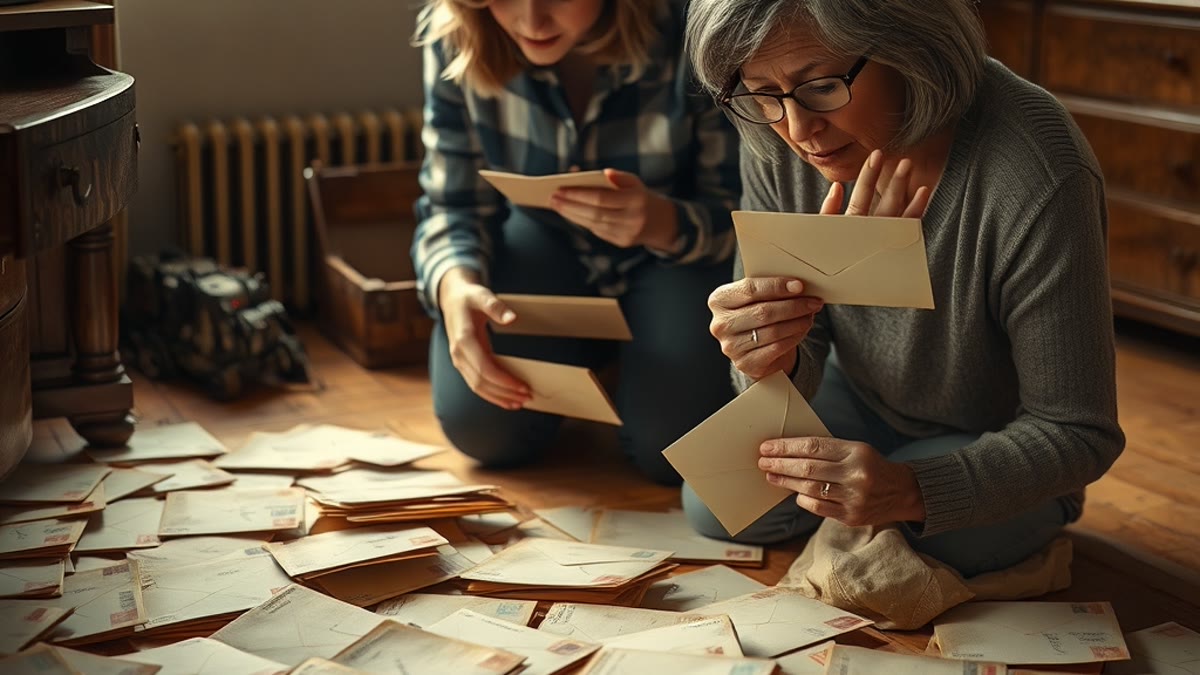
My daughter pulled a stack of stamped envelopes out of my father's desk and went white.
Previously: Six weeks after we buried my father, my daughter pried open the desk drawer he'd blocked shut and found thirty-one stamped, sealed, never-mailed envelopes — every one of them addressed to me.
I didn't open one for four days.
I want to say that was reverence. It wasn't.
It was that I was sixty-three years old and I had spent about forty of those years constructing a serviceable peace with the fact that my father was a closed man, and I understood, sitting on that study floor, that whatever was in those envelopes was going to take the peace apart.
Casey drove home to Columbus on Sunday and called me every night. "Have you opened one." "Not yet." "Mom." "I said not yet."
On Thursday I made a pot of coffee at nine in the morning like I was going to war, and I sat down at the kitchen table, and I put them in order by the dates in the corner, and I started at 1994.
Eileen. You are thirty-two years old today. You have a daughter of your own now, seven weeks, and I held her in the hospital and I could not say one word. Your mother had to take her back off me. I want to write down some things while I can still get them right.
That was the first line of the first letter.
I read it eleven or twelve times before I could go on to the second paragraph.
Because here is what I knew about my father and the day my daughter was born: he came to the hospital, he held the baby for about ninety seconds, he handed her back, he said "Well. All right then,"
and he went out to the parking lot and sat in his truck for an hour and a half.
I have told that story at dinner parties. I have told it as a joke. That's my dad. Ninety seconds and out to the truck. People laugh. I laughed.
He'd gone out there and written it down.
There are thirty-one of them and I am not going to reproduce them all, but you should know the shape of the thing, because the shape is the whole story.
They are not love letters. My father would not have known how.
They are closer to a maintenance log — which, if you knew Walter Boyd, is the most loving document he was capable of producing.
Each one is a year. Each one is specific. That's what took the wind out of me: the specificity.
1997. You got the promotion at the district office. You told us on the phone and you were talking fast the way you do when you don't want anybody to make a fuss. I made a fuss after I hung up. Your mother will confirm.
2001. You called about the divorce and I said "well, that's a shame" and then I could not think of one other thing. I want it written down that what I meant was: I would have driven up there that night. If you had asked me to come I would have left inside of ten minutes. I have thought about that phone call more than any other phone call of my life.
2009. You made me a bookshelf. You will say your husband made it and you just held the boards. You did not just hold the boards. The dado joints are square and a man who has cut a lot of dados can tell when somebody has cut a good one. It's in the study. I look at it every day.
That bookshelf is four feet from where Casey found the drawer.
2013. Your mother died in March. You did all of it. The home, the arrangements, the calls, the church ladies. I did not do any of it, because I could not, and I let a fifty-one-year-old woman who had just lost her mother carry her father as well. I know what that cost you. I am not going to be able to say this out loud so I am writing it: I am sorry, and there has never been a day I was not proud of you, and I know those are two different sentences and you have only ever gotten evidence for the first one.
I put my head down on the kitchen table on that one.
Sixty-three years old and the thing that gets you is a man's handwriting on a legal pad.
Around the fourteenth letter I started to be able to think again, and the thing I started thinking was: why.
Not why did he write them. That part I understood by then.
Writing was the only place my father could get a sentence all the way to the end without somebody looking at him while he did it.
Why did he never send them.
I had a theory and it was an ugly one, and I sat with it for two days: that he'd written them for himself. That they were a way of feeling like a father without the inconvenience of being one out loud.
That the whole shoebox was, in the end, thirty-one years of a man letting himself off the hook in private.
Then I got to 1996 and found the receipt.
It was stuck to the back of the envelope. Old adhesive, gone brown, the kind of thing you'd miss if you weren't handling every single one of them like a relic.
A cash-register receipt from the post office on Water Street. December 3, 1996. One book of stamps, thirty-two cents each, and — this is the part — one certificate of mailing, $0.55.
You buy a certificate of mailing when you want proof you sent something.
He drove to the post office. He stood in the line.
He bought the stamps and he paid the extra fifty-five cents for the receipt that proves it left your hands.
And then he brought it home again.
I sat there with that little brown scrap in my palm and every ugly theory I'd had about my father went out of me at once.
He didn't keep them because he was a coward about it. He kept them because he got all the way to the counter, thirty-one times, and each time he read it over one last time in the line and decided this one isn't good enough yet.
That's why the earlier ones are in the box, too. I went back and checked.
Some years there are two drafts. He'd keep last year's, and the next year he'd write it again, better, and seal the better one, and the old one went in behind it.
Thirty-one sealed envelopes and about nine loose drafts underneath.
My father spent thirty-one years revising a letter to me.
I asked my aunt Ruth-Ellen — his sister, eighty-eight, sharp as a tack, in a very nice place in Sandusky — what my grandfather had been like.
She laughed at me. Not unkindly.
"Nobody's asked me that in fifty years," she said.
"Your grandfather Boyd never told Walt one good thing about himself. Not one.
Walt built that man a whole hay elevator when he was seventeen years old, by himself, out of scrap, and your grandfather walked around it twice and said 'that'll want paint.'"
I said, "That's it?"
"That's it," she said. "That was the whole review."
Then she said the thing that finished the puzzle for me, and she said it like it was obvious, because to her it was:
"Honey, your father didn't know it could be said. He knew it could be written. He wrote your mother letters the whole time he was in the service and she kept every one. Paper was the only place that man was ever fluent."
The last letter is dated April 2024. He died in April 2025.
Eileen. I am eighty-six and my hands have gone and this will be the last one I can do. I have been at this since you were thirty-two and I have not managed to get one of them out the door yet. I have been telling myself I would hand you the whole box someday and let you read them all at once with me sitting there. I know now I am not going to do that either. If you have these, then I did not, and I am sorry for the way you had to get them. Everything in here is true and none of it was ever a secret from me. Your dad.
Your dad. Not Walter Boyd, which is how he signed my birthday cards for fifty years.
Here's what I've done about it, and it's the only part of this whole thing I have any control over.
Casey turned thirty-three in June.
I wrote her a letter. Six pages, longhand, and it took me nine days and I threw out two versions, which I now understand is a family trait and not a personal failing.
I wrote down the specific things. The year she was eleven and stood up to a teacher on behalf of a kid who could not stand up for himself, and how I have told that story at least fifty times.
The way she looked in the hospital corridor the night my mother died. That she is the only person in three generations of this family who has ever just walked over and pried the stuck drawer open instead of accepting that it was swollen shut, and that I want her to understand that as a description of her entire character.
And then I put a stamp on it, and I walked it down to the box on the corner, and I stood there for a minute holding it, and I heard my father in the post office line on Water Street in December of 1996 thinking this one isn't good enough yet.
And I put it in.
Then I called her and told her one of them out loud, over the phone, because I am not going to be a woman who can only do it on paper either.
She cried. I cried. It was, by the standards of the Boyd family, an absolute catastrophe.
If your father is still alive and you're reading this: he may have a drawer. He may not — plenty of men are exactly as empty as they appear, and I'm not going to tell you otherwise.
But mine had one, and I'd have given anything to know it while he was in the chair by the window.
You don't have to make him say it. Some men truly can't. Ask him to write it down.
She kept the paperwork — that is why it held up.
Are your own documents where someone could find them?