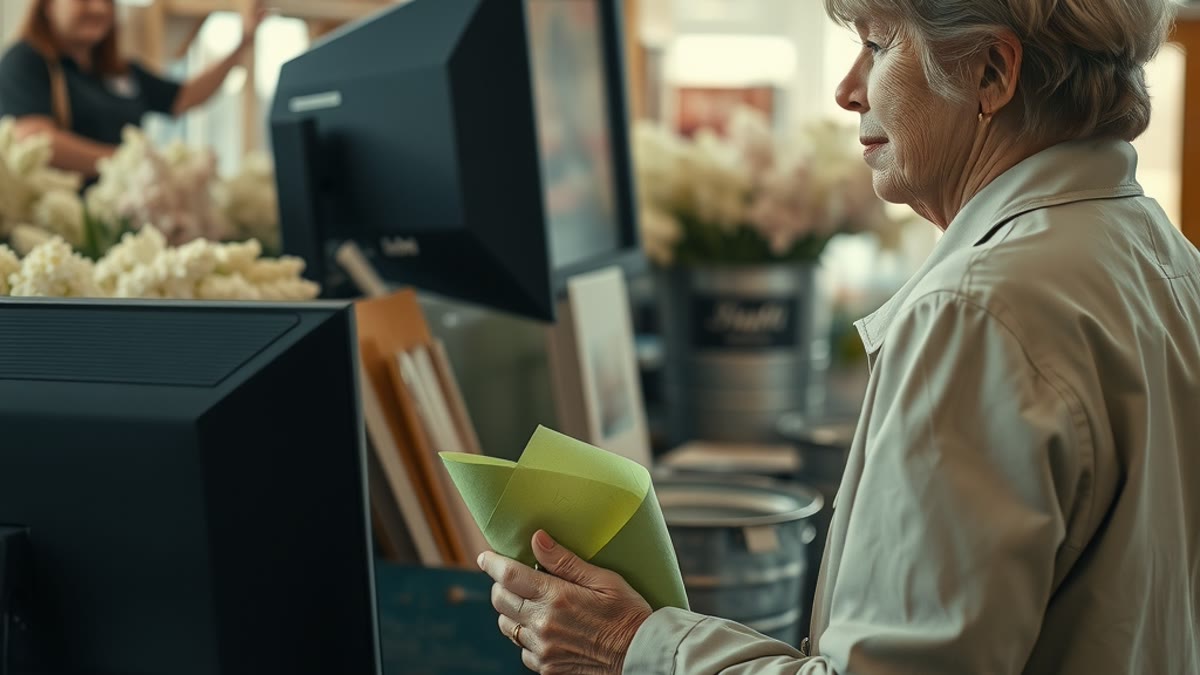
The girl behind the counter turned the screen away from me and said she wasn't allowed to tell.
Previously: For twenty-two years a stranger sent me white lilacs on my birthday, no card, no name. Last Thursday I finally walked into the shop and asked — and the girl behind the counter turned the monitor away and told me she'd been asked never to tell me.
I did not make a scene in Kestler's Flowers. I want that on the record, because a version of me might have.
I said, "I understand. Can I leave my number?"
Priya looked relieved and grateful in a way that told me she'd been braced for the other thing. She wrote it on a Post-it.
She said, "I can't promise anything, ma'am. I'll send it up the line."
I said thank you and I got in my car and I sat in the lot for about ten minutes with my hands on the wheel.
She.
Twenty-two years of being quietly, mildly afraid of a stranger who knew my address — and it was a woman. I want to be honest about what that did to me in that parking lot.
It wasn't relief exactly. It was the floor moving.
Every scenario I'd built and dismissed over two decades got swept off the table at once, and what was left was an empty room with one question standing in the middle of it.
What did I do?
She called on Sunday.
"Is this Diane Marchetti?" A younger voice than I expected.
Careful. "My name is Nadia Okafor.
Priya from the flower shop called me." A pause.
"I've been sitting here about two days trying to work out how to start."
I said, "Start with whether I know you."
And she said, "No. You don't. That's the hardest part of this for me and it always has been."
We met on Wednesday at a diner halfway between us, because she offered to drive the whole way and I said let's split it.
She's forty-one. Braids, a denim jacket, a phone she kept turning face down.
She had a manila envelope with her and she put it on the seat beside her and didn't touch it for the first half hour.
She wanted to tell it in order. I let her.
March 2003. She was nineteen, a sophomore at the state school, and thirty-one weeks pregnant.
Her mother had died the previous August.
"My mom would have been the one who handled it," she said.
"She'd have been furious for about a week and then she'd have handled it. That's who she was.
And she was just — gone. And I was the youngest of four and everybody older than me had an opinion."
The father was a boy from her Chemistry section who had stopped answering by October.
Her aunt drove down from Cleveland in September and took over, because somebody had to, and because — Nadia was careful about this, and I want to be careful about it too — her aunt was not a villain. Her aunt was a fifty-year-old woman with her own kids who had just lost her sister and was looking at a nineteen-year-old with two semesters done and no money and no mother, and she did what she genuinely believed was the loving thing.
She found a couple through the church. Good people. Vetted, home study done, a nursery already painted.
"They were kind," Nadia said. "I want that said. They wrote me a letter and it was a good letter."
The papers were drawn up. The lawyer was coming Wednesday morning.
Tuesday night Nadia's blood pressure spiked and her hands and face swelled up and the campus clinic sent her straight to the hospital, and she was admitted for observation at eleven at night, thirty-one weeks along, with the relinquishment paperwork in a folder in her aunt's tote bag on the chair.
Her aunt went home at one to get some sleep. She left the folder.
Here is what Nadia remembers.
She remembers being nineteen and alone in a dark room at three in the morning with a fetal monitor going and a folder on the nightstand that she was expected to sign in six hours.
She remembers that there was a nurse sitting in the chair beside the bed.
Not standing. Not charting.
Sitting, in a coat, with a bag on the floor — off shift, is what she understood years later, when she was old enough to know what a coat and a bag on the floor mean.
She remembers that the nurse had her hand, on top of the blanket, and had apparently been there a while.
She remembers that when she started to cry, the nurse did not tell her it was going to be all right.
"That's what I'd braced for," Nadia said.
"Everybody had been saying that for a month. And I knew it wasn't true, and every time somebody said it, it put another foot of distance between me and them."
What the nurse said instead — and she has repeated this sentence to herself thousands of times since, at 3 a.m., in her car, in a hospital corridor eleven years later when her second daughter was in the NICU — was:
"You don't have to decide tonight."
And then, after a while: "Not tonight. Tonight you're just a person in a bed with a headache.
That's all you have to be until morning. I've got you."
Nadia said the nurse stayed until shift change. That she came back once with a warm blanket out of the warmer and put it over her feet.
That at some point near dawn Nadia asked her what she should do, and the nurse said, "I'm not going to tell you that. I'll tell you that whatever you decide, you're allowed to decide it awake and rested and not at three in the morning."
By the time she thought to ask anybody's name, she'd been moved to antepartum and there was a new face on the shift.
"There was a window in that first room," she said.
"There was a bush right outside it in the dark with white flowers on it. That's the whole picture I have.
The chair, the hand, the warm blanket, and the white flowers."
I'm going to tell you what I said, because it's the worst thing I've ever had to say to another human being and I said it about nine seconds too fast.
I said, "Nadia. I don't remember it."
She nodded. She'd known. Of course she'd known — a person who remembered a night like that would have gone looking.
"How did you find me?" I asked. "If you never got a name?"
"The 2004 nurses' recognition insert in the paper," she said.
"My aunt kept it — my aunt and I are fine now, by the way, she's Grandma, she does Tuesdays. I was going through her stuff and there's a group photo of the med-surg night staff and I recognized you instantly and I have never once doubted it since."
She half smiled. "You were on the end.
You weren't looking at the camera."
She didn't sign.
She told her aunt at nine that morning that she wasn't going to, and she said her aunt sat down on the end of the bed and cried, and then said, "All right. Then we do it the other way,"
and drove back to Cleveland that weekend to get her own guest room ready.
Amara Okafor was born four weeks later, small but fine.
Amara is twenty-two.
She's a junior at Kent State. She wants to do speech pathology.
Nadia showed me a photo of a young woman in a Kent State sweatshirt sitting on a porch rail with her legs swinging, and I did the arithmetic sitting right there in the diner with a cup of coffee going cold in front of me.
Twenty-two years of flowers.
Twenty-two years old.
The count started the spring after.
That's when she opened the envelope.
Inside were twenty-two photographs. One a year. Not of the flowers. Of her.
Twenty, in a Kroger apron, with a baby on her hip. Twenty-three at a community-college graduation, dental hygiene, the baby now a kid in a church dress beside her.
Twenty-six in scrubs. Twenty-nine, pregnant with her second, Amara holding the belly with both hands.
Thirty-one. Thirty-five.
Thirty-eight, three kids and a Christmas backdrop and a husband with his hand on her shoulder. Forty.
Forty-one, this past March, in a car, arm out the window, squinting.
She laid them out on the diner table in a grid, in order, and turned them to face me.
"Every year I go put in the flower order, I take one of these," she said. "The flowers are what I send. This is what they're for."
I couldn't speak.
"It's not a thank-you present, Diane. I need you to understand that or none of it makes sense." She put her finger on the first photo, the Kroger apron, the baby. "It's a count. Every March I think, that's one more year we've been here. It's how I keep track."
She said: "You didn't make my decision for me. You did something better.
You took the decision off me for six hours so I could make it in daylight." She tapped the twenty-two photographs.
"That sentence is load-bearing. Everything on this table is standing on it."
I told her, eventually, what I'd come to say. That she'd spent twenty-two years of flower money on a woman who couldn't pick her out of a lineup, that she has three kids and a mortgage and one in college, and that I would very much like her to stop.
She heard me all the way out. Then she said no.
"You're thinking of it as a debt I'm paying you," she said.
"It isn't. It's a thing I do for me, that happens to arrive at your house."
And she was right, and I knew she was right about four words in.
So I made one amendment, and she took it.
Next March we're going together. She's driving down, and we're going into Kestler's, and she's buying her own with me standing there, and we'll take the picture together.
That'll be twenty-three.
Here's what I've been chewing on since, and it isn't comfortable, so I'll say it plain.
I worked nights for thirty-one years. I have no memory of March 2003 whatsoever.
It was a Tuesday. I sat in a chair for two hours past the end of my shift because a nineteen-year-old was awake and scared and there wasn't anybody else in the building to do it, and then I drove home and slept and went back in.
The single most load-bearing sentence of another person's entire life came out of my mouth on my own time, unremembered, unrecorded, and unrewarded — and if her aunt hadn't clipped a newspaper insert in 2004, I'd have gone to my grave never knowing there was a young woman at Kent State because of a Tuesday I can't recall.
Which means — and this is the part that keeps me up now, at sixty-five, in the little house on Ash Street —
so might you.
If you're the one sitting in the chair: you will almost certainly never find out. Do it anyway. Somebody may be counting years off it while you're standing there wondering whether you said the right thing.
And if somebody is making you decide something enormous tonight: you're allowed to decide it in daylight. Almost nothing that's real gets worse by morning.
She kept the paperwork — that is why it held up.
Are your own documents where someone could find them?